The Masala Drawer Dilemma: What Your Spice Choices Say About Who You Are Now
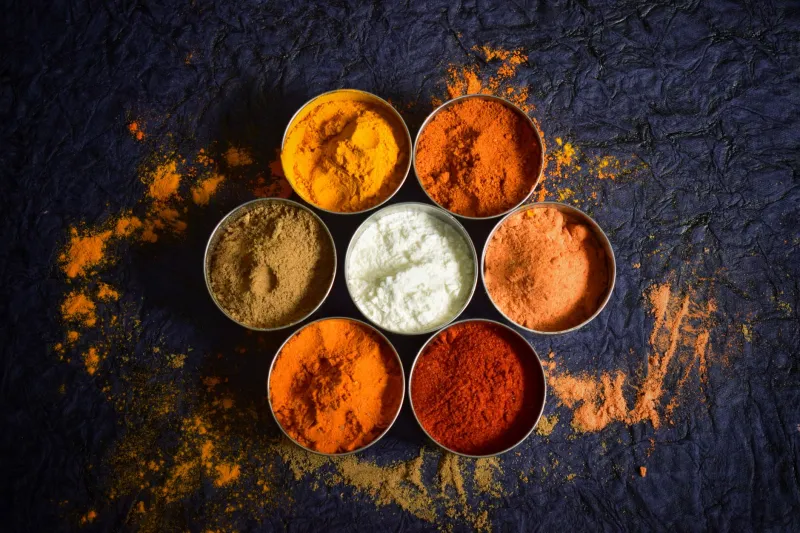
Let me describe a drawer. It's somewhere in a kitchen in suburban America — maybe Dallas, maybe Edison, maybe Fremont. Inside it, you'll find a chaotic, beautiful mess: a half-used packet of Shan Biryani masala, a little glass jar of something hand-labeled in Gujarati, a dusty container of McCormick's "Garam Masala," a whole dried kashmiri chili that somehow ended up loose at the back, and possibly a small zip-lock bag of something your mom sent in a box from back home that you're not entirely sure you should still be using.
This drawer exists in thousands of Desi households across the country. And it tells a story.
The Nostalgia Economy of Spice
Food memory is one of the most powerful kinds of memory there is. Neuroscientists have written entire papers about it. But Desi Americans don't need a research study to know that the smell of cumin hitting hot oil can transport you instantly to your grandmother's kitchen, no matter how many years or miles separate you from it.
The thing is, that memory is specific. It's not just "cumin" — it's the particular quality of the cumin your family used, the way it was stored, the ratio in which it was combined with everything else. Food nostalgia is precise. And that precision is exactly why so many Desi Americans feel a low-grade anxiety about substitutions.
When you reach for a generic grocery store spice blend because it's 9 p.m. and you're tired, you're not just making a practical choice. You're quietly negotiating with a version of yourself that learned to cook a different way. That's a lot of emotional weight for a Tuesday night dinner.
The Pre-Made Masala Debate Has Layers
Let's be honest about something: pre-made masala blends have been controversial in South Asian households for decades, long before anyone was selling them at Trader Joe's. The debate isn't new. What's new is the range of options and the cultural complexity around them.
There's a generational split happening in real time. Many first-generation immigrants carry a clear hierarchy in their heads: whole spices, freshly ground, are the gold standard. Pre-mixed blends from trusted brands are an acceptable shortcut. Mainstream American spice blends are a last resort, or not an option at all.
Their American-born or American-raised kids, though? The calculus is different. For a lot of second-generation Desis, cooking South Asian food at all is already an act of cultural reclamation — something they're learning partly from YouTube videos and partly from WhatsApp messages from their aunties. If a well-made masala blend from a Desi brand makes that process more accessible, it's not a compromise. It's a tool.
Neither position is wrong. They're just different relationships with the same food.
The Subscription Box Effect
Over the last few years, a new player has entered the chat: the specialty food subscription box. Several Desi-focused services now offer curated monthly deliveries of South Asian spices, snacks, and pantry staples — some sourced directly from small producers in India, Pakistan, Sri Lanka, and Bangladesh.
For Desi Americans who don't live near a good specialty grocery store, this has been genuinely life-changing. Suddenly you can have stone-ground Kashmiri chili powder, small-batch chaat masala from an artisan producer in Lucknow, or single-origin turmeric from a farm in Kerala — delivered to your door in Ohio.
But these services have also introduced a new kind of identity performance into the spice conversation. There's a certain cultural cachet now attached to using "authentic" single-origin spices, in the same way there's cachet around specialty coffee or small-batch olive oil. And that's worth examining with a little self-awareness. Are we buying the kasuri methi because it genuinely makes our dishes better, or because it signals something about how seriously we take our culinary heritage?
Probably both, honestly. And that's okay.
When Convenience Wins (And Why That's Fine)
Here's an opinion that might ruffle some feathers: there is nothing wrong with buying the store-brand curry powder sometimes. There. Said it.
Desi Americans are busy. Many are working demanding jobs, raising kids, managing households, and trying to maintain some version of a cultural food tradition with limited time and energy. The idea that authenticity requires a two-hour cooking process and a trip to three different specialty stores is, frankly, a luxury not everyone can afford.
Convenience isn't a betrayal of culture. It's just life. The question is whether the convenient option is actually good enough — and increasingly, the answer is "it depends on the brand and the dish."
For some recipes, a quality pre-mixed masala is genuinely indistinguishable from scratch in the final result. For others, there's no shortcut that captures the real thing. Knowing which is which is actually a form of culinary intelligence, not laziness.
What We're Really Arguing About
When Desi families argue about spices — and they do, regularly — they're usually arguing about something bigger. They're arguing about what it means to maintain culture in a country that wasn't built for it. They're arguing about whether their kids are "losing" something essential, or whether they're adapting in ways that are actually pretty remarkable.
The spice drawer is a microcosm of the larger immigrant experience: the constant negotiation between preservation and adaptation, between honoring what came before and making something workable for the life you're actually living.
At Apna Market, we see this tension play out every day — in what people search for, what they buy, what they write in reviews. Someone ordering the specific brand of amchur their mother used. Someone else buying a sampler pack of regional masalas they've never tried before. Both of those are valid. Both of those are Desi.
Your masala drawer doesn't have to be perfectly curated or ideologically consistent. It just has to feed the people you love. The rest is details.